
You brought home a puppy. Congratulations — and welcome to the beautiful chaos.
One of the very first questions every new puppy parent asks is: how much should I actually feed this little one? Too little and you risk poor growth. Too much and you set them up for weight and joint problems later. And somewhere in between is the sweet spot that most first-time owners spend weeks trying to figure out.
The good news? It is simpler than it looks. A clear puppy feeding schedule by age takes the guesswork out completely.
In this guide, you will learn exactly how many meals to give at each life stage, how to choose the right food, how portions change as your pup grows, and what to watch for to know you are getting it right. Whether you have a tiny Beagle or a fast-growing Golden Retriever — one of the most friendly dog breeds around — this guide has you covered.
Table of Contents
- Why a Feeding Schedule Matters for Puppies
- Puppy Feeding Schedule by Age: The Complete Breakdown
- How Much to Feed: Portion Guide by Size and Age
- Choosing the Right Puppy Food
- Feeding Tips for the Most Friendly Dog Breeds
- Signs You Are Feeding Your Puppy Correctly
- Common Feeding Mistakes to Avoid
- FAQs
- Conclusion
Why a Feeding Schedule Matters for Puppies
Puppies are not simply small adult dogs. Their bodies are developing at a rapid pace — bones, muscles, organs, and immune systems are all forming simultaneously. That means their nutritional needs are uniquely high and also change quickly.
A consistent puppy feeding schedule by age does more than just keep your pup fed. It supports stable blood sugar levels, aids digestion, makes potty training significantly easier, and helps you spot any health issues early. When a dog that normally wolfs down every meal suddenly ignores their bowl, you notice — because there is a routine to compare against.
Free-feeding (leaving food out all day) might seem convenient, but it makes it nearly impossible to monitor intake, leads to overeating in many breeds, and complicates house training. Scheduled meals are always the better choice.
Puppy Feeding Schedule by Age: The Complete Breakdown
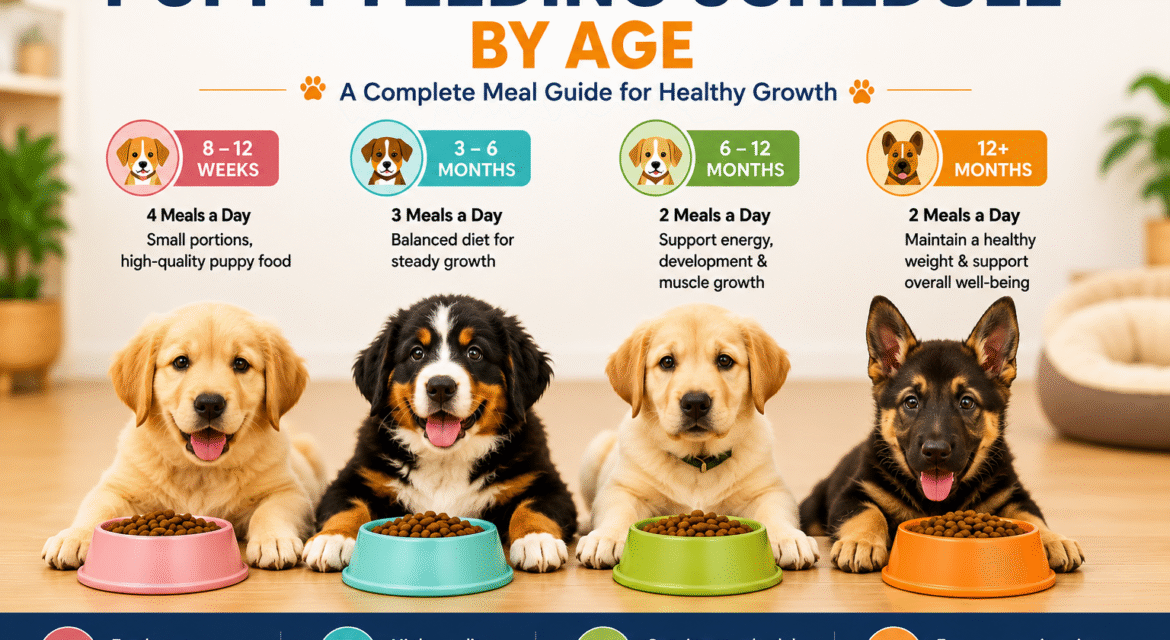
Direct Answer: Puppies need 4 meals per day from 6–12 weeks, 3 meals from 3–6 months, and 2 meals from 6–12 months onward.
Here is the full breakdown:
| Age | Meals Per Day | Notes |
|---|---|---|
| 6 – 8 weeks | 4 meals/day | Transition from mother’s milk to solid food |
| 8 – 12 weeks | 4 meals/day | Consistent schedule builds digestive routine |
| 3 – 6 months | 3 meals/day | Morning, midday, and evening |
| 6 – 12 months | 2 meals/day | Morning and evening |
| 12 months+ | 2 meals/day | Begin gradual transition to adult food |
Space meals evenly throughout the day. For a pup on 4 meals a day, think 7 am, 12 pm, 5 pm, and 9 pm. For 3 meals, something like 7 am, 1 pm, and 7 pm works well.
How Much to Feed: Portion Guide by Size and Age
Meal frequency is only half the picture. The amount you feed matters just as much — and it varies significantly based on your puppy’s current weight and expected adult size.
Small Breeds (adult weight under 10 kg)
Small breed puppies have fast metabolisms but tiny stomachs. They need calorie-dense food in smaller, more frequent portions. Most small breed puppy foods come with clear weight-based guidelines on the packaging — follow these closely.
Medium Breeds (adult weight 10–25 kg)
Medium breeds have the most straightforward feeding needs. They grow steadily without the extreme growth spurts seen in large breeds. Follow packaging guidelines and adjust upward slightly if your pup looks lean, or reduce slightly if the belly is getting round.
Large and Giant Breeds (adult weight 25 kg+)
This is where most owners make mistakes. Large breed puppies like Labradors, German Shepherds, and Golden Retrievers grow rapidly, and overfeeding causes serious skeletal issues. Use large-breed-specific puppy food, which has a controlled calcium-to-phosphorus ratio designed for slower, safer bone development. Do not add calcium supplements unless a vet specifically prescribes them.
General rule across all sizes: You should be able to feel your puppy’s ribs with light pressure but not see them. A visible waist when viewed from above is ideal.
Choosing the Right Puppy Food
With hundreds of options on the market, the choice can feel overwhelming. Here is a simple framework.
Check the first ingredient. It should be a named protein — chicken, turkey, salmon, or lamb. If the first ingredient is a grain or something vague like “meat meal,” put it back.
Choose age-appropriate food. Food labelled “for all life stages” is technically acceptable, but puppy-specific formulas are better optimised for growth. Large breed puppies especially benefit from large-breed-specific formulas.
Dry kibble vs. wet food. Dry kibble is convenient, supports dental health, and is generally more economical. Wet food is higher in moisture, which is helpful for puppies who do not drink enough water. Many owners combine both.
Grain-free? Unless your vet has identified a specific grain allergy, there is no strong evidence that grain-free diets are superior for most puppies. Whole grains provide useful energy and fibre.
Foods that are toxic to all dogs — no exceptions:
- Onions and garlic
- Grapes and raisins
- Chocolate
- Xylitol (found in some peanut butters and sugar-free products)
- Cooked bones (raw meaty bones can be appropriate with guidance, but cooked bones splinter dangerously)
- Alcohol and caffeine
Feeding Tips for the Most Friendly Dog Breeds
Some of the world’s most friendly dog breeds are also the most commonly overfed. Here is what to keep in mind.
Golden Retriever
Golden Retrievers are enthusiastic eaters who will rarely turn down a meal. They are prone to weight gain and hip dysplasia. Stick to measured portions and resist the urge to free-feed. Choose a large-breed puppy formula and avoid excess treats during training — use kibble from their daily allowance instead.
Labrador Retriever
Labradors have a genetic mutation that affects the gene responsible for feeling full. Many Labradors genuinely cannot tell when they have eaten enough. This makes strict portion control essential from puppyhood. Puzzle feeders and slow-feed bowls can help extend mealtimes and prevent bloat.
Beagle
Beagles are food-motivated to an extreme degree, which makes training easy but weight management harder. They do well on scheduled meals with no free feeding. Measure every portion and account for training treats in their daily calorie total.
Cavalier King Charles Spaniel
One of the most affectionate and friendly breeds, Cavaliers are moderate eaters but prone to cardiac issues as they age. Keeping them lean from puppyhood is one of the best things you can do for their long-term heart health.
Poodle (all sizes)
Poodles are active and intelligent. They burn energy well but can develop digestive sensitivities. Introduce new foods gradually and watch for loose stools as an early sign of intolerance.
Signs You Are Feeding Your Puppy Correctly
Not sure if you have got it right? Look for these indicators:
- Healthy weight: Ribs felt but not visible; visible waist from above
- Steady energy: Playful and alert between meals, not lethargic
- Good coat: Shiny, smooth coat suggests good nutrition
- Firm stools: Well-formed stools signal appropriate portion size and food tolerance
- Consistent growth: Regular weight gain appropriate for breed size
If your puppy has a pot belly outside of mealtimes, this can signal intestinal worms rather than overfeeding — a vet check is worthwhile.
Common Feeding Mistakes to Avoid
Feeding adult food too early. Adult food does not have enough protein, fat, or key nutrients for a growing puppy. Always use puppy-specific food until the right age.
Switching food suddenly. Always transition over 7–10 days by mixing increasing amounts of new food with old food. Sudden switches cause digestive upset in almost every breed.
Giving too many treats. Treats should make up no more than 10% of your puppy’s daily calorie intake. Factor them in, especially during training-heavy periods.
Skipping meals to “build hunger.” This is not necessary and can cause blood sugar dips in small breed puppies. Stick to the schedule.
Adding unnecessary supplements. Unless your vet recommends it, extra calcium, vitamins, or fish oil is not needed if your puppy is already on a complete and balanced puppy food.
❓ Frequently Asked Questions
Q: How many times a day should I feed a 3-month-old puppy? A: A 3-month-old puppy should be fed 3 times a day — morning, midday, and evening. Before 3 months (6–12 weeks), puppies need 4 meals a day because their small stomachs cannot hold enough food in fewer sittings.
Q: When should I switch from puppy food to adult food? A: For small and medium breeds, switch at around 12 months. For large and giant breeds, wait until 15–18 months when their skeletal growth is mostly complete. Always transition gradually over 7–10 days to avoid digestive upset.
Q: Can I feed my puppy home-cooked food instead of kibble? A: Yes, but it requires careful planning. Home-cooked meals are not automatically complete and balanced. If you choose this route, work with a veterinary nutritionist to ensure your puppy gets adequate protein, calcium, phosphorus, and essential vitamins. A certified puppy multivitamin supplement is usually necessary.
Q: My puppy leaves food in the bowl. Should I worry? A: Occasional pickiness is normal. Remove the uneaten food after 15–20 minutes and offer the next scheduled meal at the regular time. If your puppy consistently refuses food for more than two meals in a row, especially if combined with lethargy or vomiting, contact your vet.
Q: Is it okay to give a puppy cow’s milk? A: Most puppies are lactose intolerant after weaning and cow’s milk commonly causes diarrhoea. Avoid it unless your vet recommends otherwise. Fresh water is all a healthy puppy needs to drink.
Conclusion
A consistent puppy feeding schedule by age is one of the simplest and most effective things you can do for your puppy’s health. Start with four meals a day for young pups, step down as they grow, choose a quality food matched to their size and breed, and keep portions measured.
Whether you have one of the most friendly dog breeds like a Golden Retriever or a lively mixed breed, the foundations of good nutrition are the same — the right food, the right amount, at the right times.
Looking for high-quality puppy food, slow feeders, and nutritional supplements trusted by pet parents worldwide? Explore the full range at puppyshop.in and give your pup the best possible start.